
Table of Contents
Overview of Virtual Reality Development Trends
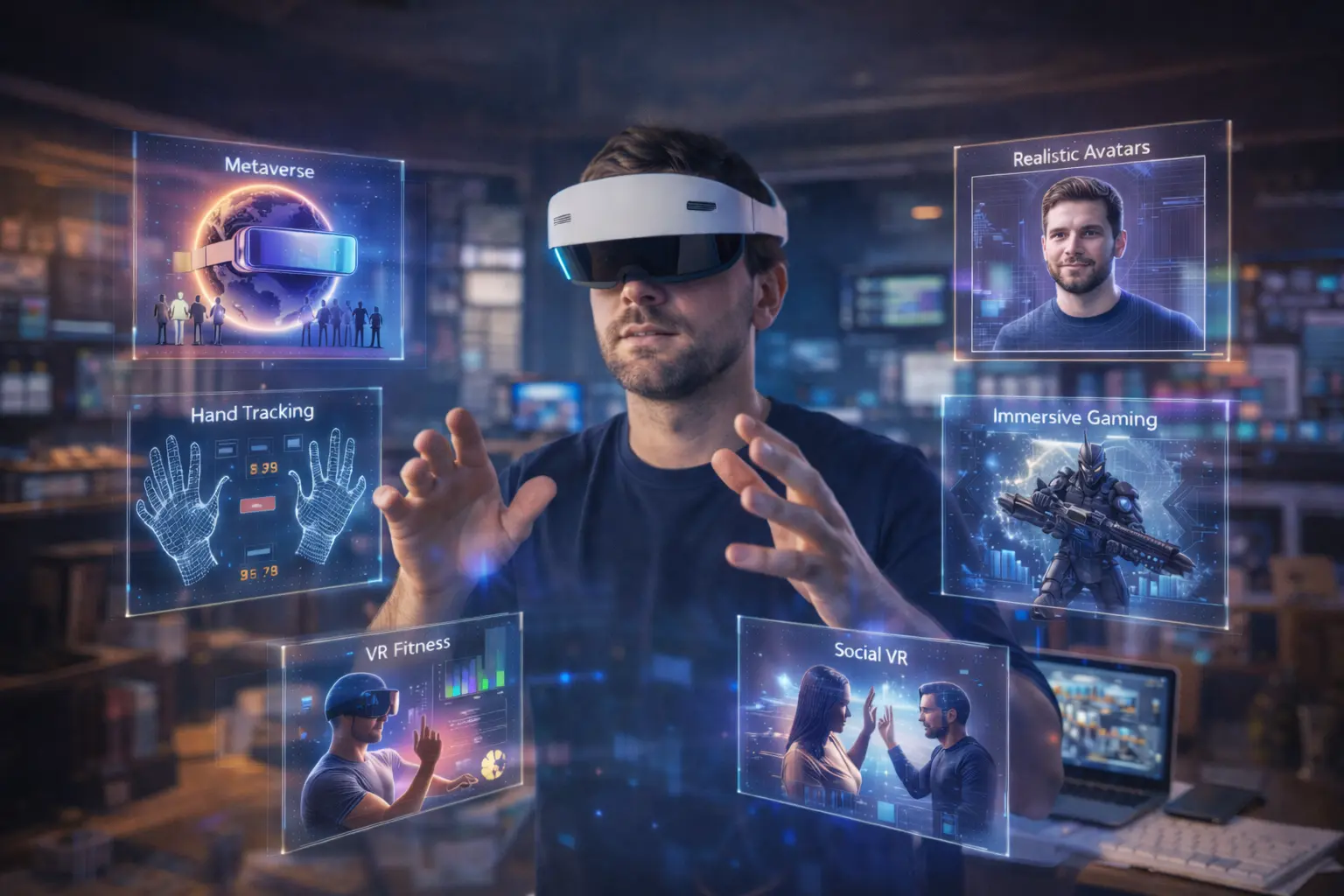
Virtual reality is no longer an experimental technology reserved for gaming labs and innovation showcases. Today, virtual reality development is shaping how enterprises train teams, how customers experience products, and how digital interaction evolves across industries. As hardware becomes more accessible and software frameworks mature, virtual reality development trends are moving rapidly from novelty to necessity.
Businesses planning future-ready digital strategies must understand how virtual reality development trends in 2026 are redefining immersive experiences. From enterprise training to real-time collaboration, modern VR solutions are becoming smarter, scalable, and deeply integrated into business ecosystems. As a forward-thinking VR company, Quantile Tech closely tracks these developments to deliver future-proof immersive systems.
Enterprise-Focused Virtual Reality Development Trends
One of the most significant virtual reality development trends is the strong shift toward enterprise adoption. Earlier VR experiences were often consumer-centric, but modern virtual reality development is now built for training, simulation, onboarding, safety drills, and operational efficiency.
Organisations use VR solutions to simulate complex environments that would otherwise be expensive, risky, or impossible to recreate physically. Manufacturing plants, healthcare institutions, logistics providers, and defense organizations rely on immersive training platforms powered by advanced virtual reality development frameworks. These enterprise VR systems focus on precision, repeatability, and measurable outcomes rather than entertainment alone.
As virtual reality development trends in 2026 evolve, enterprise VR will continue integrating analytics, AI-driven feedback loops, and performance tracking. Quantile Tech, as an experienced VR company, designs enterprise-grade VR platforms that align immersive technology with business objectives, scalability, and long-term ROI.
AI-Driven Virtual Reality Development Trends in 2026
Artificial intelligence is playing a defining role in shaping virtual reality development trends in 2026. AI enhances realism, responsiveness, and personalization within immersive environments. Instead of static VR simulations, modern virtual reality development incorporates intelligent virtual agents, adaptive scenarios, and predictive learning paths.
AI-powered VR solutions can modify environments in real time based on user behavior, skill progression, and decision patterns. For example, training simulations can dynamically adjust difficulty levels, introduce new variables, or simulate unpredictable outcomes—making learning far more effective.
Among the emerging virtual reality development trends, AI integration enables voice recognition, gesture understanding, emotional response tracking, and intelligent non-player characters. Quantile Tech leverages these virtual reality development innovations to create immersive experiences that feel natural, contextual, and deeply interactive—setting a new benchmark for enterprise VR platforms.
Cross-Platform and Cloud-Based Virtual Reality Development Trends
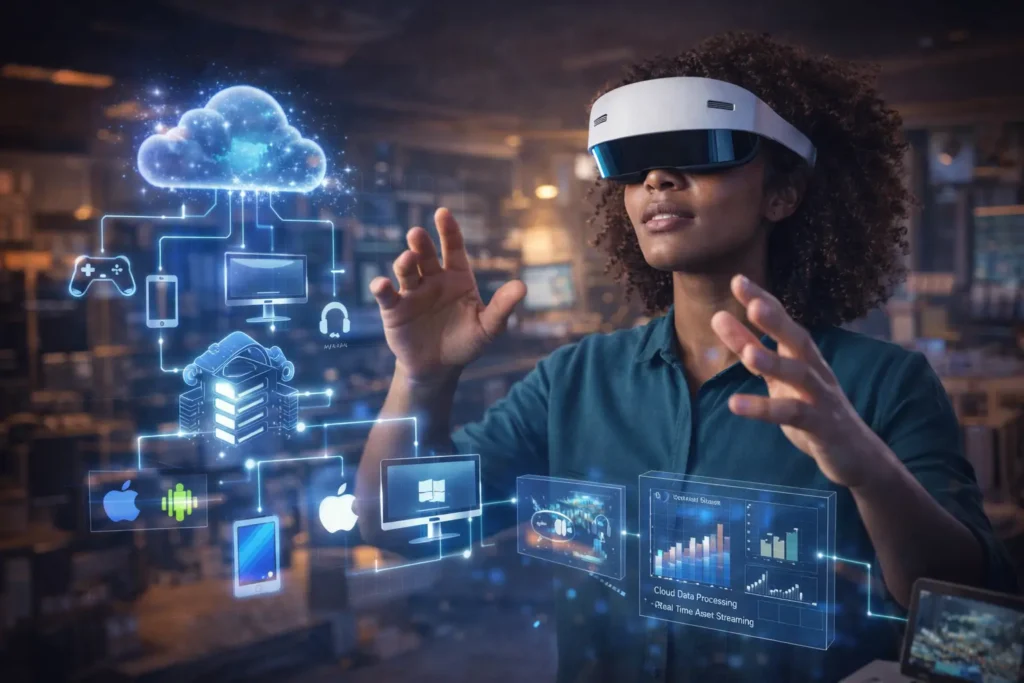
Another critical shift in virtual reality development trends is the move toward cloud-enabled and cross-platform VR ecosystems. Traditional VR systems often relied on high-end hardware and local processing, limiting scalability. Modern virtual reality development prioritizes flexibility and accessibility.
Cloud-based VR solutions allow users to access immersive experiences across devices, locations, and teams without heavy infrastructure investments. These systems support remote collaboration, multi-user simulations, and centralized content updates—key requirements for global organizations.
As virtual reality development trends in 2026 progress, cross-platform compatibility will become essential. Enterprises expect VR applications to function seamlessly across headsets, desktops, and mobile devices. Quantile Tech, as a future-ready VR company, builds cloud-integrated VR environments that ensure consistent performance, secure data handling, and effortless scalability across platforms.
Hyper-Realistic Content as a Virtual Reality Development Trend
Visual fidelity and realism continue to dominate virtual reality development trends. Advances in rendering engines, photogrammetry, spatial audio, and physics simulation have elevated the quality of immersive environments. Today’s virtual reality development focuses on making virtual spaces indistinguishable from the real world.
Hyper-realistic VR solutions are particularly valuable in industries such as architecture, healthcare, manufacturing, and defense, where precision matters. Accurate lighting, lifelike textures, real-time shadows, and spatial depth significantly improve user immersion and decision-making.
Among the most impactful virtual reality development trends in 2026, realism is no longer about aesthetics alone—it influences training accuracy, safety preparedness, and operational confidence. Quantile Tech applies advanced virtual reality development pipelines to deliver high-fidelity immersive environments optimized for both performance and realism.
Scalable VR Solutions and Modular Virtual Reality Development Trends
Scalability has become a defining factor in virtual reality development trends. Organizations no longer want isolated VR pilots—they demand modular, expandable platforms that evolve with business needs. Modern virtual reality developmentemphasizes reusable components, configurable environments, and modular architecture.
Modular VR solutions allow companies to add new scenarios, locations, and training modules without rebuilding entire systems. This approach significantly reduces development costs and deployment timelines while ensuring long-term adaptability.
As virtual reality development trends in 2026 mature, modular frameworks will dominate enterprise adoption. Quantile Tech designs scalable virtual reality development ecosystems that grow alongside organizations, ensuring consistent performance, easy upgrades, and future compatibility.
User-Centric Design Driving Virtual Reality Development Trends
User experience has become central to virtual reality development trends. Early VR systems often suffered from motion sickness, complex navigation, and steep learning curves. Today’s virtual reality development prioritizes comfort, intuitive controls, and natural interaction.
Human-centered design principles are now deeply embedded in VR solutions, focusing on ergonomics, accessibility, and cognitive ease. Eye-tracking, gesture recognition, voice commands, and haptic feedback are shaping how users interact within immersive environments.
Among key virtual reality development trends in 2026, user-centric design ensures higher adoption rates and better engagement outcomes. Quantile Tech integrates these principles into every virtual reality development project, creating immersive systems that are powerful yet effortless to use.
Conclusion: Why Virtual Reality Development Trends Matter for the Future
Understanding virtual reality development trends is no longer optional for organizations planning long-term digital strategies. As immersive technology becomes deeply integrated into business operations, staying aligned with virtual reality development trends in 2026 ensures competitiveness, efficiency, and innovation readiness.
From AI-driven intelligence and cloud-based delivery to hyper-realism and modular scalability, modern virtual reality development is transforming how businesses train, collaborate, and engage. Choosing the right VR solutions and working with an experienced VR company is essential to unlocking real value from immersive technology.
Quantile Tech continues to lead the way by aligning emerging virtual reality development trends with enterprise-grade execution—helping organizations adopt VR not just as a tool, but as a strategic advantage.