

Table of Contents
Overview of Benefits of Virtual Reality in Education
The education industry is undergoing a significant transformation as digital technologies redefine how knowledge is delivered and absorbed. Among these innovations, virtual reality stands out as a powerful tool for reshaping learning environment. The benefits of virtual reality in education go far beyond visual appeal—they enable immersive, experiential learning that traditional classrooms often struggle to deliver. As schools, universities, and training institutions explore advanced learning models, the benefits of virtual reality in the education industry are becoming increasingly evident.
By simulating real-world environments and abstract concepts, virtual reality allows learners to interact with content rather than passively consume it. This shift supports deeper understanding, higher retention, and improved engagement. Leading organizations, including every forward-thinking VR company, are investing in VR solutions that cater specifically to modern education needs. Companies like Quantile Tech are at the forefront, developing scalable virtual reality platforms that align with evolving academic and institutional goals.
Benefits of Virtual Reality in Education for Immersive Learning Experiences
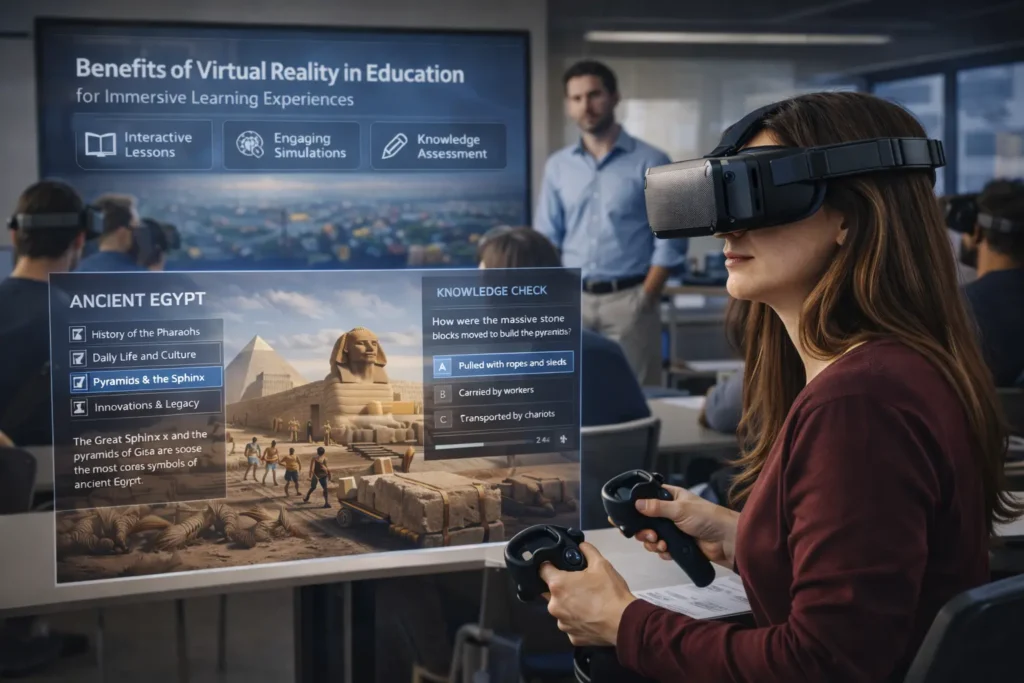
One of the most impactful benefits of virtual reality in education is its ability to deliver immersive learning experiences. Unlike textbooks or videos, virtual reality places learners inside a simulated environment where they can explore, interact, and learn by doing. This immersive nature makes learning more intuitive and memorable.
In subjects such as science, history, and geography, virtual reality allows students to explore complex concepts in three-dimensional spaces. Learners can walk through the human body, travel back in time to historical events, or observe natural phenomena up close. These experiences are difficult—if not impossible—to replicate in traditional classrooms. As a result, the benefits of virtual reality in the education industry include improved comprehension and long-term knowledge retention.
Educational institutions adopting VR solutions report increased student engagement and participation. Learners are more focused and motivated when lessons feel interactive and experiential. A reliable VR company like Quantile Tech designs virtual reality environments that are aligned with curriculum objectives, ensuring that immersive experiences translate into measurable learning outcomes. This demonstrates how the benefits of virtual reality directly support modern pedagogical goals.
Benefits of Virtual Reality in Education for Enhanced Student Engagement
Student engagement is a persistent challenge in modern education, especially in digital and hybrid learning environments. One of the strongest benefits of virtual reality in education is its ability to capture and sustain learner attention. Virtual reality transforms lessons into interactive experiences that encourage curiosity and active participation.
Instead of passively listening to lectures, students using virtual reality are required to explore, make decisions, and respond to scenarios. This active involvement improves focus and reduces distractions. The benefits of virtual reality in the education industry are particularly visible in younger learners and digital-native students who respond positively to immersive technologies.
Institutions leveraging advanced VR solutions have observed improvements in attendance, participation, and overall academic interest. A forward-looking VR company like Quantile Tech builds virtual reality platforms that balance engagement with instructional structure. This ensures that the excitement of immersive environments supports learning objectives rather than overshadowing them. Ultimately, the benefits of virtual reality extend to improved motivation and a more dynamic classroom experience.
Benefits of Virtual Reality in Education for Experiential and Practical Learning
Experiential learning is essential for subjects that require hands-on practice, yet traditional education often limits real-world exposure due to cost, safety, or logistical constraints. One of the most practical benefits of virtual reality in education is its ability to simulate real-life scenarios in a controlled, risk-free environment.
Through virtual reality, students can practice experiments, technical procedures, or professional tasks without physical limitations. Medical students can perform virtual surgeries, engineering students can assemble complex machinery, and vocational learners can practice job-specific skills. These applications highlight the benefits of virtual reality in the education industry, particularly in skill-based and professional training programs.
High-quality VR solutions enable repeatable practice, allowing learners to refine their skills at their own pace. A specialized VR company like Quantile Tech develops realistic simulations that mirror industry standards, ensuring that virtual practice aligns with real-world expectations. This approach demonstrates how the benefits of virtual reality support competency-based education and workforce readiness.
Benefits of Virtual Reality in Education for Personalized Learning Paths
Every learner has unique strengths, learning speeds, and preferences. Traditional classrooms often struggle to accommodate this diversity. One of the most valuable benefits of virtual reality in education is its ability to support personalized learning experiences tailored to individual needs.
Virtual reality platforms can adapt content difficulty, pacing, and scenarios based on learner performance. Students can revisit challenging concepts, explore advanced topics, or learn through different interaction styles. These personalized experiences are among the most impactful benefits of virtual reality in the education industry, as they promote inclusivity and equal learning opportunities.
Advanced VR solutions also provide educators with data-driven insights into student behavior and progress. A data-focused VR company such as Quantile Tech integrates analytics into virtual reality environments, enabling instructors to monitor performance and customize instruction. Through this approach, the benefits of virtual reality extend beyond learners to educators, empowering more effective teaching strategies.
Benefits of Virtual Reality in Education for Remote and Collaborative Learning
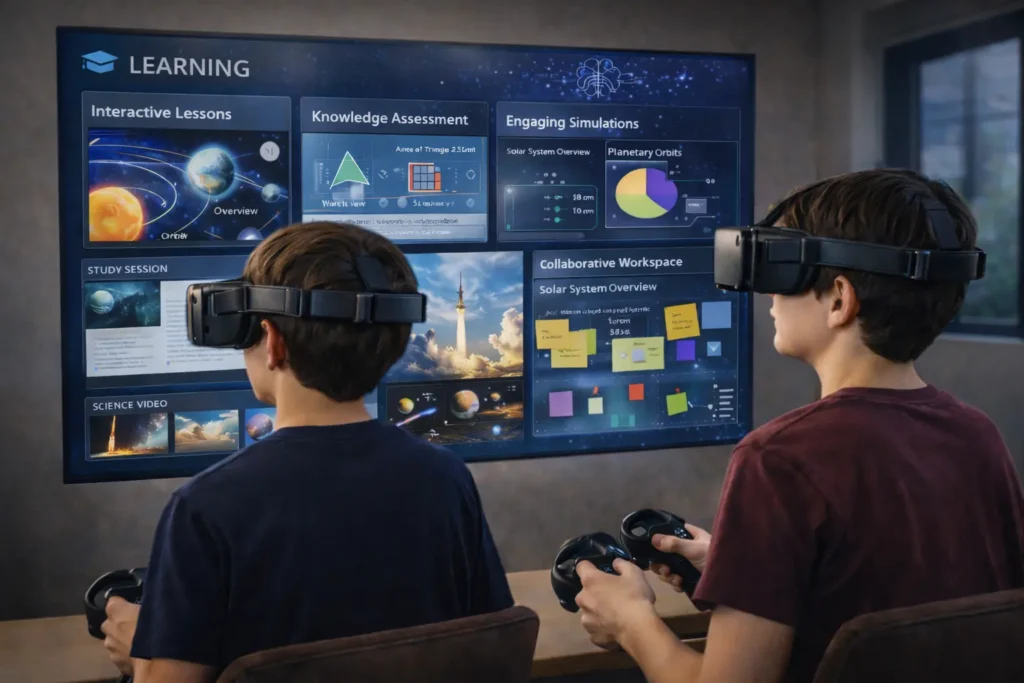
As remote and hybrid learning models become more common, maintaining interaction and collaboration is a growing challenge. One of the emerging benefits of virtual reality in education is its ability to create shared virtual spaces where learners can collaborate regardless of physical location.
Virtual classrooms enable students and instructors to meet, interact, and work together in immersive environments. These collaborative experiences replicate the social dynamics of physical classrooms while offering greater flexibility. The benefits of virtual reality in the education industry include stronger peer interaction, improved communication skills, and enhanced group learning outcomes.
Modern VR solutions support multi-user environments, virtual discussions, and collaborative problem-solving tasks. A global VR company like Quantile Tech designs secure and scalable virtual reality platforms that support remote collaboration without compromising educational quality. These capabilities reinforce how the benefits of virtual realityalign with the evolving demands of modern education systems.
Conclusion: The Long-Term Benefits of Virtual Reality in Education
The benefits of virtual reality in education are redefining how learning is experienced, delivered, and measured. From immersive exploration and enhanced engagement to practical skill development and personalized learning, virtual reality addresses many limitations of traditional education models. As digital transformation accelerates, the benefits of virtual reality in the education industry will continue to expand across academic, professional, and lifelong learning environments.
Institutions that invest in high-quality VR solutions position themselves for long-term success by offering engaging, inclusive, and future-ready education. Partnering with an experienced VR company such as Quantile Tech ensures that virtual reality implementations are pedagogically sound, scalable, and aligned with institutional goals. Ultimately, the benefits of virtual reality lie in its ability to make learning more meaningful, accessible, and effective for learners worldwide.