


Table of Contents
Understanding the Benefits of Virtual Reality in Aerospace
The aerospace industry operates in one of the most complex, high-risk, and precision-driven environments in the world. From aircraft design and manufacturing to pilot training and maintenance operations, every process demands accuracy, safety, and efficiency. This is where the benefits of virtual reality in aerospace become increasingly significant. Virtual reality is redefining how aerospace organizations train professionals, simulate environments, and optimize decision-making.
By enabling immersive simulations and realistic digital environments, virtual reality allows aerospace companies to reduce operational risks, lower costs, and improve performance outcomes. The benefits of virtual reality in aerospace extend across civil aviation, defense, space exploration, and manufacturing. Supported by a capable VR development company like Quantile Tech, aerospace organizations can unlock measurable value through advanced VR development solutions.
Enhancing Aerospace Training Through Virtual Reality Solutions
One of the strongest benefits of virtual reality in aerospace is its ability to transform training programs. Traditional aerospace training methods rely heavily on physical simulators, classroom instruction, and real aircraft exposure, all of which are expensive and logistically complex. Virtual reality introduces immersive training environments that replicate real-world aerospace scenarios with remarkable accuracy.
Through VR development platforms, pilots, engineers, and technicians can practice procedures in simulated cockpits, control rooms, and maintenance bays. The advantages of virtual reality in aerospace training include reduced risk, repeatable learning, and consistent skill assessment. Trainees can experience emergency scenarios, system failures, and mission-critical tasks without endangering lives or equipment.
A trusted VR development company like Quantile Tech designs aerospace training simulations that improve skill retention, shorten learning curves, and ensure operational readiness. These benefits of virtual reality in aerospace make VR an essential component of modern aerospace training strategies.
Improving Design and Engineering Efficiency Using Virtual Reality
Another key area showcasing the best benefits of virtual reality in aerospace is aircraft design and engineering. Aerospace components are complex, and even minor design errors can lead to costly revisions. Virtual reality enables engineers to visualize, test, and refine designs before physical prototypes are created.
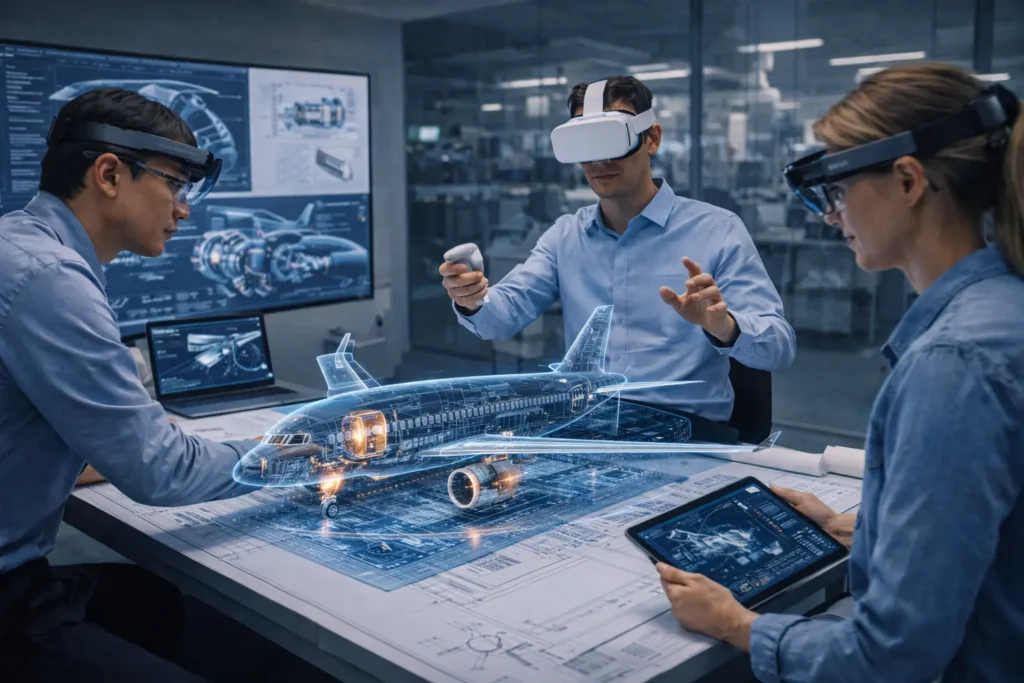
By using VR development tools, aerospace teams can conduct virtual walkthroughs of aircraft interiors, engine assemblies, and structural components. The advantages of virtual reality in aerospace design include early detection of flaws, enhanced collaboration, and faster iteration cycles. Engineers can interact with full-scale digital models, improving spatial understanding and design accuracy.
Quantile Tech, as an experienced VR development company, builds custom VR environments that help aerospace organizations streamline design validation processes. These benefits of virtual reality in aerospace reduce development time, lower prototyping costs, and improve overall engineering quality.
Virtual Reality for Maintenance, Repair, and Overhaul Operations
Maintenance, Repair, and Overhaul (MRO) operations are critical to aerospace safety and reliability. One of the most practical benefits of virtual reality in aerospace is its impact on maintenance training and execution. Virtual reality allows technicians to rehearse complex maintenance procedures in a controlled environment before performing them on actual aircraft.
With VR development solutions, technicians can visualize internal systems, practice disassembly and reassembly, and identify potential faults. The advantages of virtual reality in aerospace MRO include reduced human error, faster task completion, and improved compliance with safety standards. Virtual simulations also help standardize maintenance procedures across global teams.
A specialized VR development company like Quantile Tech delivers immersive MRO training solutions that enhance technical accuracy and operational confidence. These benefits of virtual reality in aerospace directly contribute to aircraft safety and lifecycle efficiency.
Boosting Safety and Risk Management with Virtual Reality
Safety is non-negotiable in aerospace operations. One of the most impactful benefits of virtual reality in aerospace is its ability to enhance safety training and risk preparedness. Virtual reality enables teams to experience hazardous scenarios that are impossible or unsafe to recreate in real life.
Through VR development simulations, aerospace personnel can train for emergency landings, system malfunctions, space mission anomalies, and extreme environmental conditions. The best benefits of virtual reality in aerospace safety training include improved situational awareness, faster decision-making, and reduced accident rates.
Quantile Tech, as a forward-thinking VR development company, builds safety-focused virtual reality environments that help organizations anticipate risks and improve response strategies. These advantages of virtual reality in aerospace ensure better preparedness without exposing teams to real-world danger.
Supporting Aerospace Collaboration and Remote Operations
Global collaboration is essential in aerospace projects involving multinational teams and distributed operations. One of the emerging benefits of virtual reality in aerospace is its ability to enable immersive remote collaboration. Virtual reality allows engineers, designers, and decision-makers to meet in shared virtual spaces regardless of physical location.
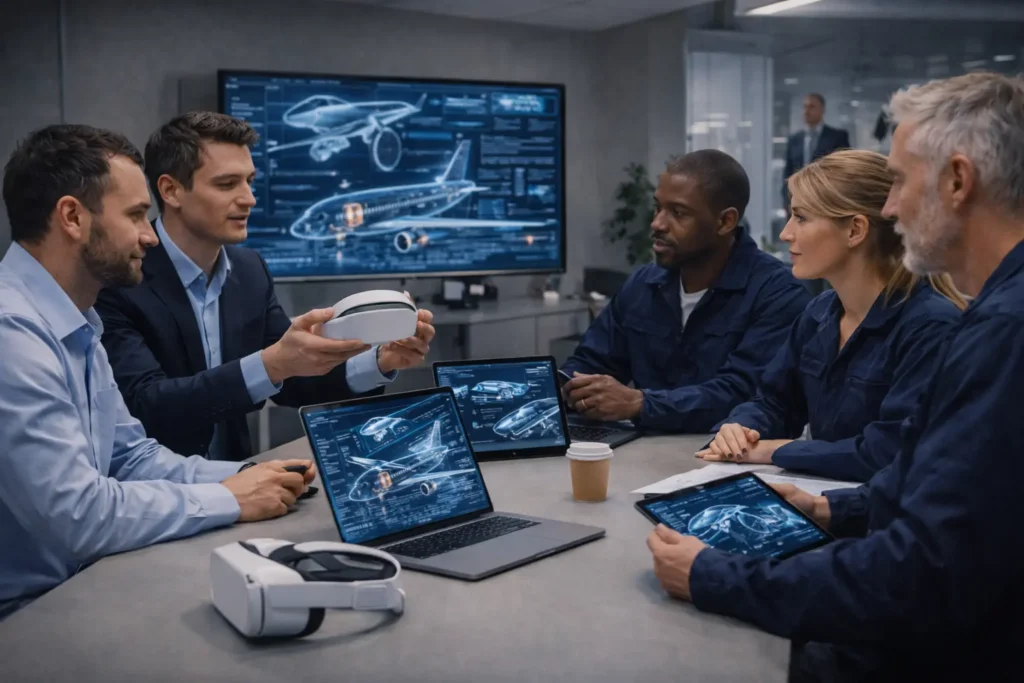
VR development platforms support real-time collaboration on digital aircraft models, mission planning simulations, and operational reviews. The advantages of virtual reality in aerospace collaboration include reduced travel costs, faster approvals, and improved communication clarity. Teams can interact with complex data visually rather than relying on static documents.
A capable VR development company like Quantile Tech creates collaborative VR environments that support secure, scalable aerospace workflows. These benefits of virtual reality in aerospace help organizations maintain efficiency in an increasingly globalized industry.
Long-Term Advantages of Virtual Reality in Aerospace
The aerospace industry continues to evolve, and immersive technology is playing a central role in that transformation. The benefits of virtual reality in aerospace span training, design, maintenance, safety, and collaboration. By leveraging virtual reality, aerospace organizations can improve efficiency, reduce risk, and accelerate innovation.
With support from a trusted VR development company like Quantile Tech, aerospace leaders can harness the best benefits of virtual reality in aerospace to stay competitive in a demanding global market. As VR development continues to mature, its role in aerospace will only become more essential, shaping the future of aviation and space exploration.