
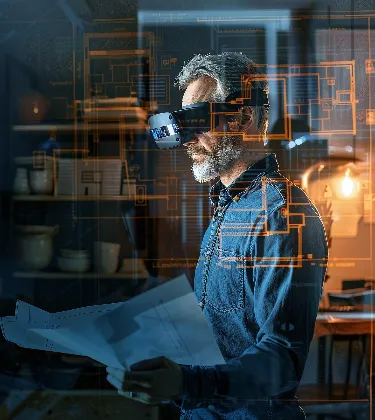
Visualize designs, streamline collaboration, and reduce costly rework with immersive VR solutions for architecture, engineering, and construction. With VR walkthroughs and interactive models, project teams can inspect design details early and make informed decisions before construction begins.
Immersive AR VR in construction workflows enable stakeholders to validate structural choices, improve safety planning, and strengthen on-site coordination. Quantile Tech, as a leading VR company, provides enterprise-grade AR solutions that seamlessly support AR and VR in architecture workflows. These AR VR applications in construction ensure higher accuracy, reduced risk, and improved decision-making across the project lifecycle.

One industry that’s truly poised for immersive transformation is Architecture, Engineering, and Construction (AEC). VR enables teams and clients to experience a space before it’s built, eliminating guesswork and enhancing communication among global stakeholders. This is especially valuable when rework costs are high and design opinions differ. The AEC industry sounds like a perfect use case for VR and MR(Mixed Reality).
 Urban Infrastructure (Building, Stadium, Dam) Stakeholder Buy-In
The adoption of AR and VR in construction provides unmatched clarity during design reviews, strengthening collaboration across architecture, engineering, and project management teams. Quantile Tech delivers advanced solutions for AR in architecture, VR in engineering, and AR in civil engineering, helping teams visualize infrastructure with precision. Through AR VR in architecture, teams address issues proactively and integrate client feedback more efficiently.
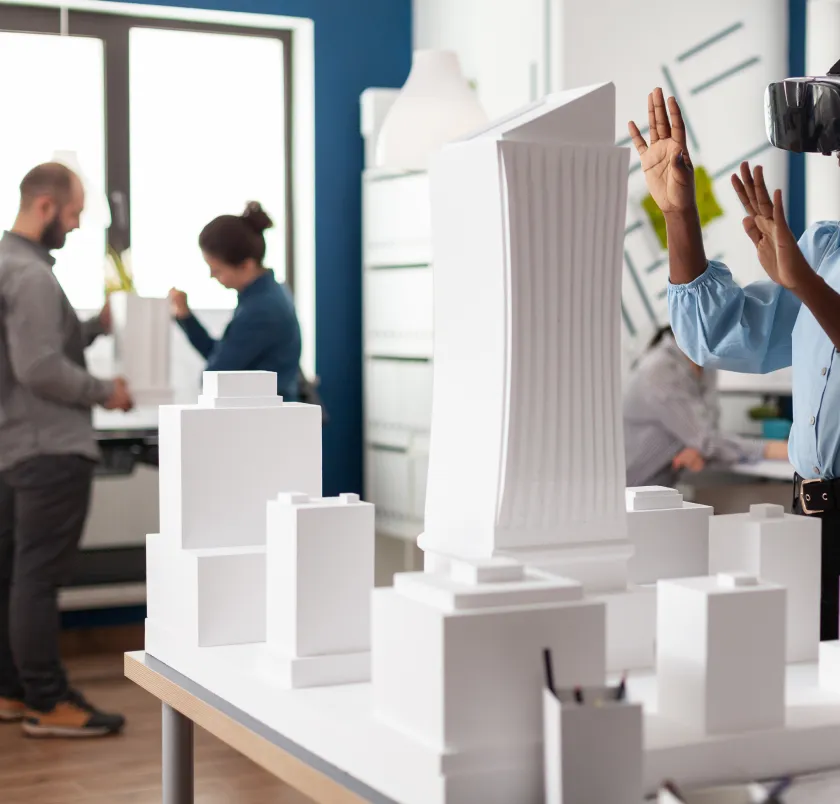
Traditionally, urban planning relied on paper blueprints, scale models, and 2D drawings—offering stakeholders limited ability to imagine a project’s real-world impact. Communities were dependent on static visuals and artistic interpretations to understand a development’s scope or environmental influence.
With modern AR VR applications in construction, stakeholders can explore infrastructure at life scale and identify issues long before physical work begins. Quantile Tech’s immersive solutions help architects, contractors, engineers, financiers, and consultants collaborate in real time. This blend of architecture in VR and AR in engineering enhances transparency, reduces risk, and accelerates approval processes. Today, AR and VR in architecture empower teams to bring clarity and confidence to complex building and infrastructure projects.
Collaboration lies at the heart of every successful construction project, and immersive technologies significantly strengthen this dynamic. AR/VR in architecture supports multi-user environments where architects, engineers, designers, and clients can meet inside a virtual building model regardless of their physical location. They can review structural changes, compare design alternatives, and resolve conflicts in real time. This level of shared understanding leads to faster decision-making and eliminates the misinterpretations often associated with traditional review methods.
Quantile Tech’s VR engineering environments offer highly accurate simulations that replicate lighting conditions, structural behavior, and functional space usage. Engineers can test mechanical systems, evaluate safety protocols, and forecast real-world performance with unparalleled precision. The integration of AR into architecture also elevates client engagement. Clients who may struggle to interpret technical drawings can now explore lifelike simulations of their future buildings, making informed choices regarding layouts, materials, and aesthetics. This results in higher satisfaction and smoother project approvals.
Accurate planning and predictive analysis are essential in the AEC industry. AR VR in construction dramatically improves these capabilities by offering a realistic preview of potential outcomes. By identifying issues early and enabling proactive adjustments, immersive technologies reduce risks associated with costly mid-project changes. Quantile Tech’s VR company expertise ensures that these immersive platforms integrate seamlessly with existing BIM workflows, reinforcing accuracy and enhancing project feasibility. For evaluating load-bearing elements, simulating construction stages, or forecasting environmental impact, VR in engineering provides a robust foundation. AR in civil engineering complements this by offering on-site verification and supporting real-time corrections.
Through advanced AR solutions and immersive VR tools, Quantile Tech ensures that stakeholders across architecture, engineering, and construction complete their projects with greater confidence, efficiency, and precision.
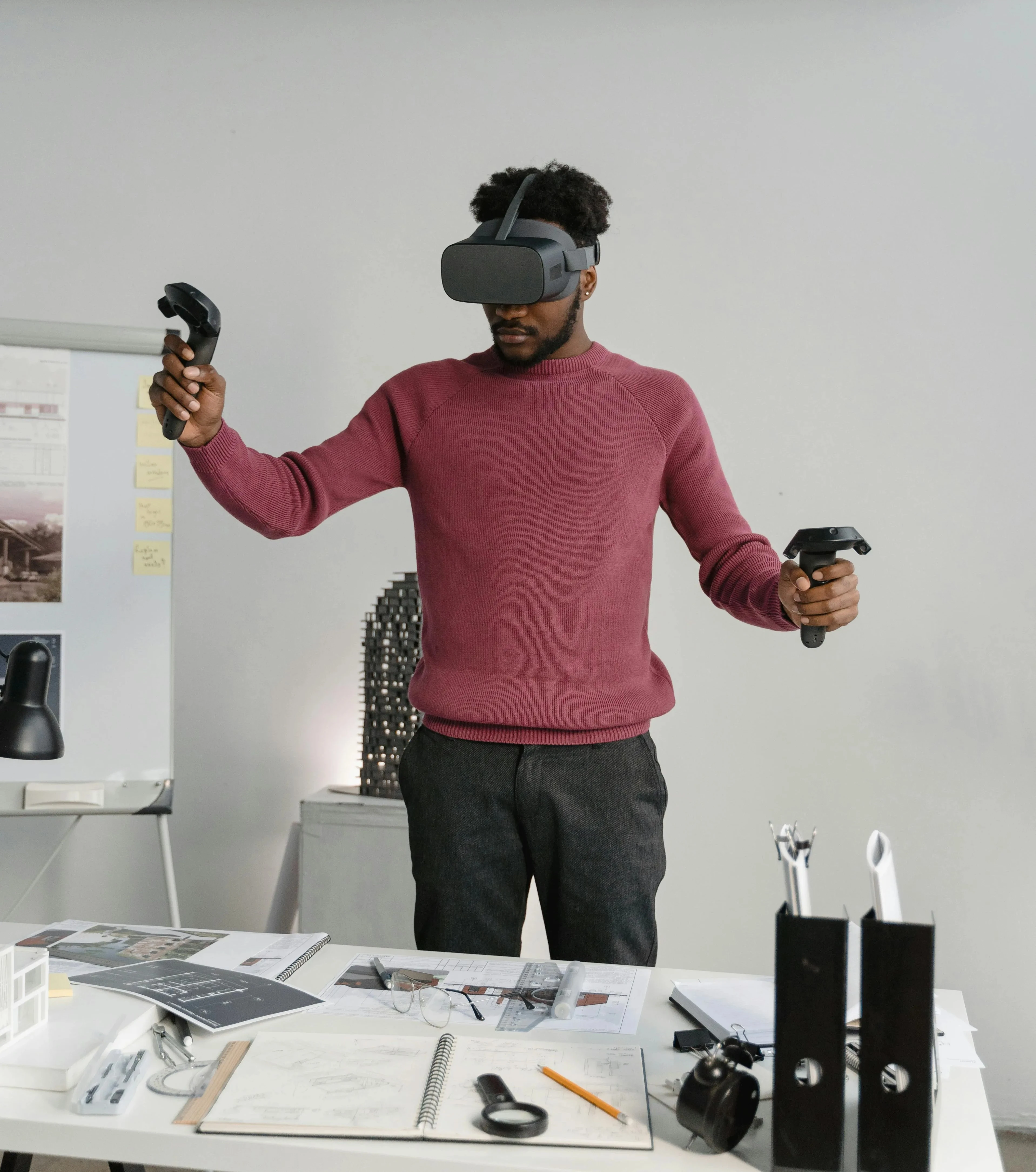
Modern engineering teams rely heavily on accuracy, and immersive digital technologies are making precision easier than ever. AR in engineering allows professionals to overlay technical data, structural layouts, and mechanical components directly onto real-world environments. This improves field inspections, reduces human errors, and ensures alignment between the digital model and the physical build. VR in engineering further enhances this workflow by recreating complex systems in immersive environments where teams can simulate stress tests, validate assembly sequences, and run feasibility studies without relying on physical prototypes. Engineers can visualise underground utilities, analyse structural behaviours, or review complicated MEP layouts using VR simulations that replicate real-world conditions.
Quantile Tech’s advanced AR solutions support these workflows with enterprise-level reliability, allowing engineering teams to adopt AR and VR in construction processes with confidence. As a leading VR company, Quantile Tech empowers organisations to streamline operations, accelerate design iterations, and deliver safer, more efficient engineering outcomes.
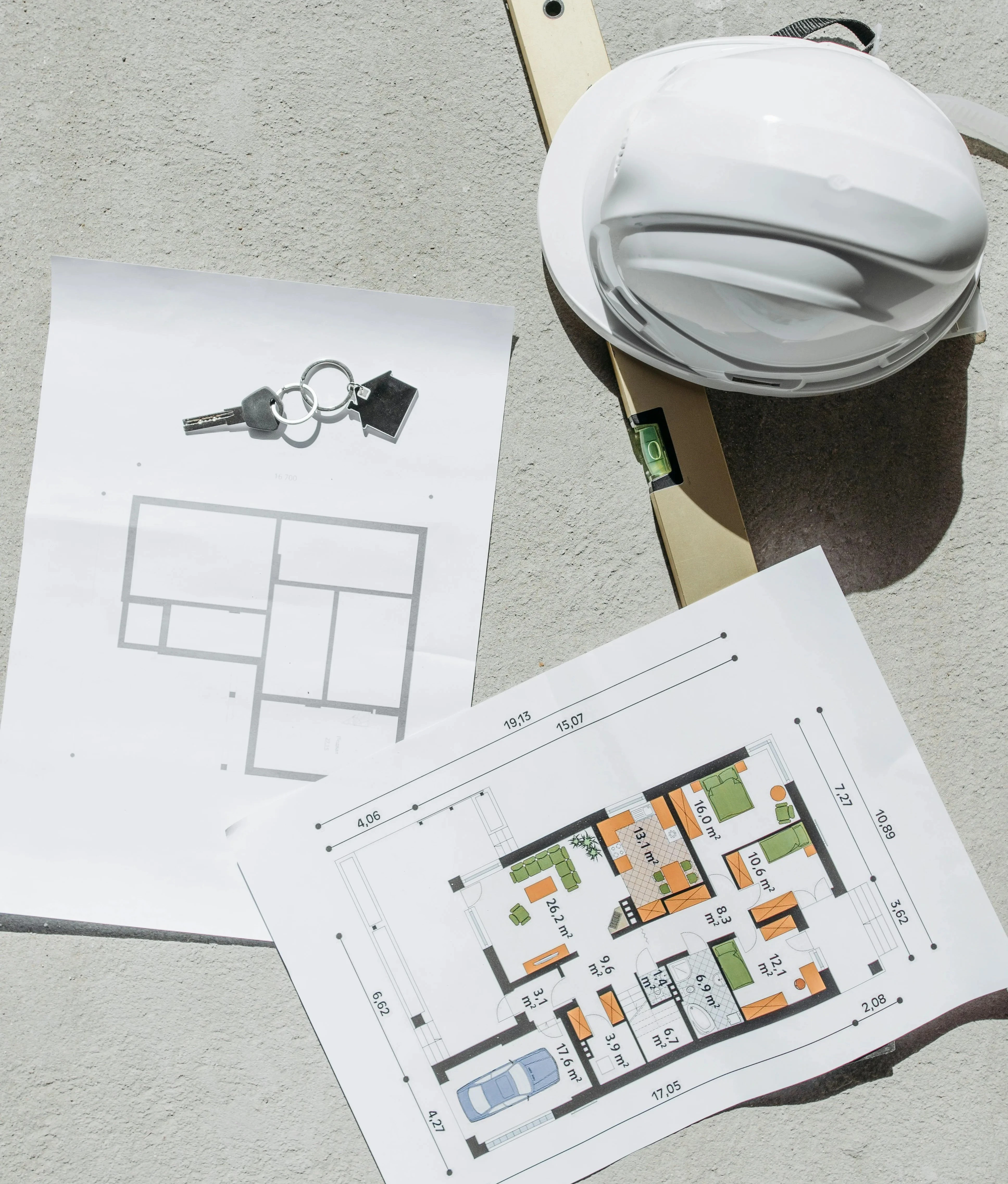
Civil engineering projects involve extensive planning, complex workflows, and constant on-site decision-making. AR in civil engineering is transforming how field teams interpret drawings, assess progress, and track deviations. By integrating AR VR in construction workflows, civil engineers gain a clearer understanding of design intent and execution accuracy. Quantile Tech’s AR solutions support large infrastructure projects where scale, environmental factors, and timelines demand absolute precision. The combination of AR and VR in construction enhances planning, strengthens communication among teams, and ensures that complex civil engineering tasks are executed with greater efficiency and reliability.
AR in civil engineering further elevates this process by enabling planners to project proposed structures directly onto existing landscapes. This allows for an accurate understanding of scale, environmental integration, and aesthetic impact. As a result, approvals accelerate, and potential conflicts are identified long before construction begins. Teams gain the ability to foresee challenges related to spatial fit, material selection, or structural behavior, making AR and VR in architecture indispensable tools for modern urban construction workflows.


